



Contextual Attack Path Intelligence
DarChain: Digital Attack Risk Contextual Hyper-Analysis Insights
Achieve Strategic Calm: Master Your Adversarial Narrative with External Contextual Attack Path Intelligence
You have done everything the industry has advised: investing millions in a 20+ tool security stack, building a world-class SOC, and ticking every framework box from NIST to ISO. Yet the "Perpetual Crisis Posture" persists, and 76% of organizations still suffer breaches from exposed assets that legacy tools fail to prioritize. You aren’t just fighting external attackers; you’re battling a "Hidden Tax on your SOC" where exhausted analysts spend 30 minutes on each siloed alert, while the true breach narrative develops in your blind spots. Introducing ThreatNG DarChain (Digital Attack Risk Contextual Hyper-Analysis Insights Narrative), the fundamental shift from static discovery to predictive storytelling. By correlating technical gaps with brand, social, and regulatory signals, DarChain delivers the Strategic Calm needed to disrupt an attacker’s sequence before it reaches your most valuable assets.
The Power of DarChain: Changing Findings to Attack Paths
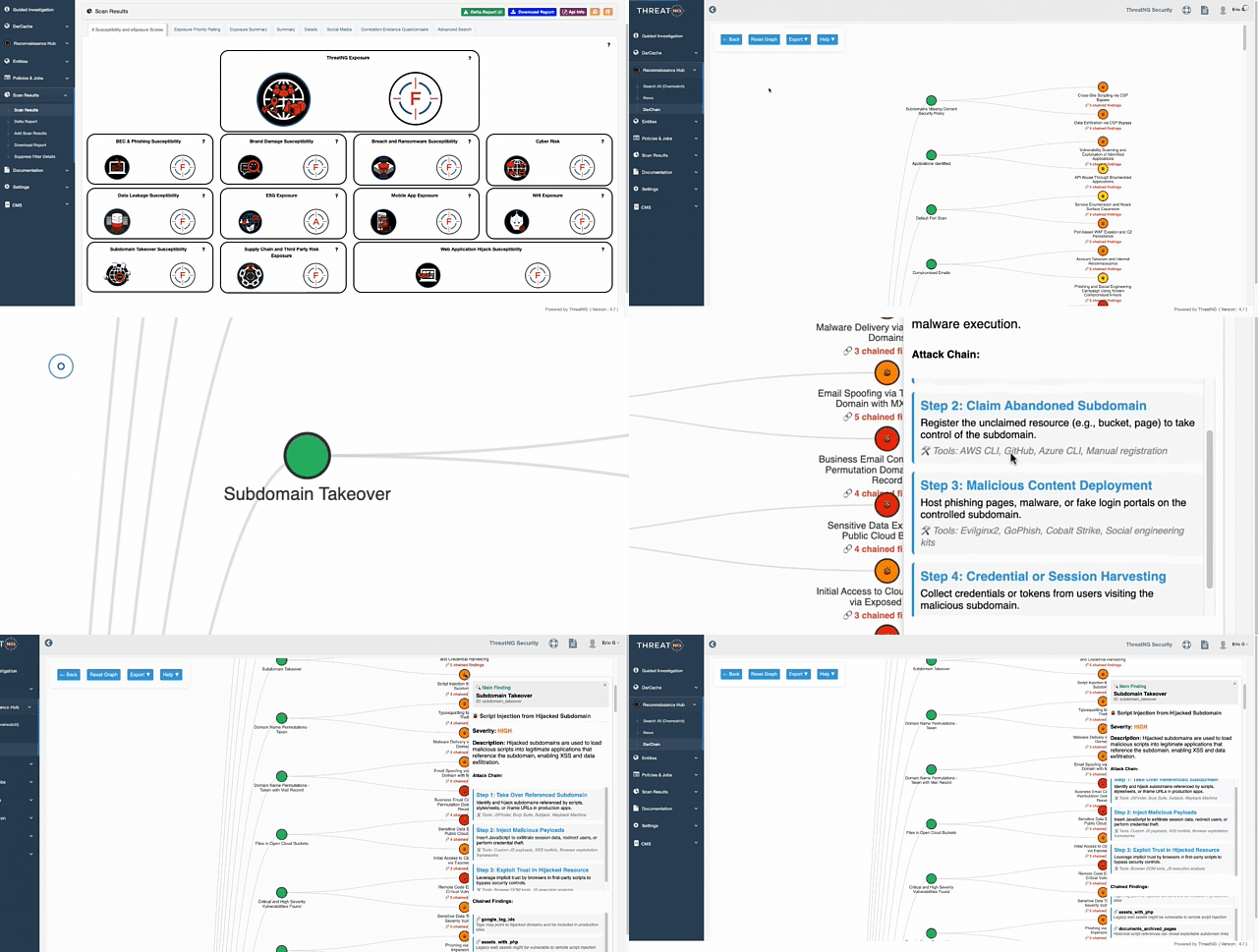
In the world of cybersecurity, a single vulnerability rarely tells the whole story. ThreatNG DarChain (Digital Attack Risk Contextual Hyper-Analysis Insights Narrative) is a proprietary engine that moves beyond static lists of alerts. It "chains" disparate findings together to reveal the exact Attack Paths an adversary would use to breach your organization.

Why “Chaining” Matters
Most security tools provide a "flat" view of risk, treating a leaked password and a misconfigured server as unrelated issues. DarChain provides the 3D view. By linking technical flaws with social and organizational exposures, it highlights the compounded risk that simple scanners miss.
Contextual Prioritization: Focus on "low-risk" findings that, when chained, create "high-impact" breaches.
Predictive Defense: See the next move an attacker is likely to take based on the current chain.
Narrative Clarity: Translate complex technical gaps into a step-by-step story that stakeholders can understand.
How DarChain Builds the Narrative: 4 Step Process
To map an attack path, the DarChain engine follows a rigorous logic-based workflow:
Continuous Discovery: We use an outside-in approach to map your entire digital footprint, including Shadow IT, cloud buckets, and social footprints, precisely as an attacker sees it.
Cross-Domain Correlation: The engine analyzes findings across three distinct layers: Technical (software/infra), Social (leaked PII/profiles), and Organizational (business relations/disclosures).
Logical Linkage: DarChain applies "Adversarial Logic" to determine if one finding facilitates another. For example: Does this leaked employee email (Social) make this unpatched VPN (Technical) a high-probability entry point?
Path Mapping: These links are forged into a visual, step-by-step attack path, identifying the "Choke Points" where you can most effectively break the chain.
Transform Abstract Data into Actionable Intelligence
DarChain clarifies key stakeholder questions, transforming abstract data into actionable intelligence.
The insights gained within DarChain serve as a strategic pivot point, enabling users to leverage other ThreatNG capabilities to uncover deeper layers of their attack surface and dismantle the adversary’s narrative.
For example…
CISOs and Strategic Leaders
Objective: Risk Quantification and Resource Allocation
External Exposure Questions
"What is our real-world exposure?"
Move beyond high-level security ratings to see the actual exploit paths an attacker could take.
"Which risks justify immediate budget or resource allocation?"
Identify "High-Velocity" paths (e.g., 3-step chains) that pose an immediate danger to the brand.
"What is the potential business impact of a non-technical event?"
Understand how a lawsuit or an ESG violation can be weaponized for a technical breach.
The Strategic Pivot
DarChain insight directs a CISO to the ThreatNG Security Ratings. For example, if DarChain reveals multiple paths leading to "Credential Theft," the CISO can use the Ratings module to see how these specific vulnerabilities are dragging down the organization's overall "Web Application Hijack Susceptibility" score.
Security Teams and SOC Analysts
Objective: Technical Detection
External Exposure Questions
"How does an attacker get from Point A to Point B?"
Access the step-by-step technical sequence (Attack Chain and Tools) of a potential breach.
"What are our 'Choke Points'?"
Identify the single finding that, if fixed, breaks multiple different attack paths simultaneously.
"Which tools are the adversary likely to use against us?"
List the specific Adversary Arsenal (like Nuclei, Subjack, or Cobalt Strike) the team should monitor in logs.
The Analyst Pivot
Once an analyst identifies a "Choke Point" (e.g., a Subdomain Takeover), they can use the Domain Intelligence module to perform a deeper dive. They can pivot from the DarChain narrative to the Domain Intelligence module to find every other CNAME record pointing to that same vulnerable vendor.
GRC (Governance, Risk, and Compliance) Professionals
Objective: Regulatory Alignment and Risk Oversight
External Exposure Questions
"Where are our compliance gaps visible to the public?"
See what an unauthenticated attacker sees, including missing HSTS headers and exposed SEC filing data.
"How could a regulatory filing owner be targeted?"
Discover how public records are used to profile and spear-phish high-level executives.
"What is the relationship between our financial disclosures and our cyber risk?"
Map the Chained Relationship between corporate transparency and adversary interest.
The Compliance Pivot
Insight from the Sentiment and Financials paths leads GRC teams to Search Engine Exploitation investigation modules. If DarChain shows that "Executive Blackmail" is a viable path, the team can use the Search Engine Exploitation module to identify which sensitive "Website Control Files" are indexing internal directories.
Stop Managing Alerts, Start Managing Risk: Eliminating the Hidden Tax on Your SOC
Eliminate the "Hidden Tax on the SOC" and End Vigilance Burnout
Stop paying for silence and start investing in certainty. DarChain resolves the "Crisis of Context" by treating findings as Chained Relationships (aka Exploit Chains, Attack Strings, or Multi-Stage Correlation) rather than isolated alerts. By identifying Attack Path Choke Points, critical technical or social nodes where multiple potential breach narratives intersect, you empower your team to achieve a 10x security impact with less manual effort. This directly combats the burnout affecting 67% of CISOs, allowing your team to stop "clearing alerts" and begin winning the operational war.
Expose the "Invisible Surface" of Web3 and Non-Human Identities (NHI)
Adversaries have moved beyond the technical perimeter, yet your legacy EASM hasn’t. DarChain offers an "outside-in" view of your Web3 Attack Surface and the "machine ghosts" of Non-Human Identity (NHI) Exposure, including high-privilege API keys and service accounts found in public code repositories that are usually invisible to internal tools. By proactively identifying decentralized .eth and.crypto domain impersonations and machine-level credential leaks, you disrupt the common enemy's playbook in the reconnaissance phase, the critical moment when they are most vulnerable.
Secure the Boardroom with Legal-Grade Attribution and Strategic Control
Shift from being the "Protector" to the "Business Enabler" with Legal-Grade Attribution. DarChain is the only capability that correlates real-time technical risks with your organization's public SEC 8-K/10-K filings and ESG violation signals, identifying where technical reality might contradict your public risk disclosures. When the Board asks, "Are we safe?" you won't respond with a list of CVEs. You will lead with the strategic confidence of a CISO who knows precisely how their remediation strategy aligns with material business risk and regulatory mandates.
Breaking the Attack Narrative:
Achieving Operational Certainty Across the Digital Surface

External Attack Surface Management (EASM)
From Chaos to Control: Ending the Identity Crisis of Your External Perimeter
You have mapped your assets, but do you know their story? Most CISOs are drowning in discovery data, while 76% of organizations still suffer breaches from "known" assets that are never contextualized. DarChain shifts you from the exhaustion of "patching everything" to the Strategic Calm of knowing exactly which external path leads to your crown jewels.
Disrupt the Adversarial Narrative Before the Breach: While legacy EASM gives you a list of ports, DarChain provides Adversarial Narrative Mapping, showing you the "movie" of an attack before it happens so you can break the chain at the reconnaissance stage.
Eliminate the "Hidden Tax on the SOC": Stop wasting 30 minutes on every siloed alert. DarChain identifies Attack Path Choke Points — the critical technical nodes where multiple breach paths intersect—allowing your team to achieve 10x the security impact with a fraction of the manual labor.
Master the "Unauthenticated Edge": Gain absolute visibility into shadow IT and abandoned resources without requiring internal connectors or agents, and see exactly what a motivated adversary sees from the outside in.

Digital Risk Protection (DRP)
Silence the Noise: Transform Public Chatter into Predictive Defense
The internet is a weapon being used against your people and your brand, with $17,700 lost every minute to phishing and credential theft. You aren't just defending a network; you are fighting a "Conversational Attack Surface" where Reddit threads and Dark Web leaks become the blueprint for your next crisis. DarChain turns this noise into high-fidelity intelligence, protecting your leaders and your reputation.
Weaponize the "Conversational Attack Surface": DarChain transforms unmonitored public chatter on forums like Reddit and the Dark Web into an early warning system, identifying targeted social engineering plans before they reach your employees’ inboxes.
Neutralize "Machine Ghosts" with NHI Exposure Ratings: Secure the high-privilege machine identities, such as the API keys and service accounts found in public code repositories that traditional Digital Risk Protection tools miss, closing the door on malware-free identity attacks.
Prevent Career-Ending Reputation Loss: Use Legal-Grade Attribution to connect technical leaks with brand risks, ensuring you are the most prepared person in the boardroom when the CEO asks about the latest breach headline.

Security Ratings
The Certainty Deficit: Moving Beyond Arbitrary Scores to Irrefutable Proof
Traditional security ratings are a "black box" of arbitrary numbers that leave you defensive and frustrated. You’ve done the work, but can you prove it? ThreatNG Veracity™ replaces guesswork with Legal-Grade Attribution, transforming ambiguous findings into a narrative of operational excellence that the Board can actually understand.
Replace Scores with Stories: Move from a static "B" to a narrative-driven risk map that correlates technical gaps with actual business impact, making it easy to justify security investments to non-technical stakeholders.
Irrefutable Evidence for Board Disclosures: DarChain is the only capability that correlates real-time technical risks with your organization’s public SEC filings, identifying where technical reality might contradict your regulatory risk oversight statements.
Operationalize Positive Security Indicators: Validate your strengths, not just your weaknesses. Highlight the presence of WAFs, MFA, and robust headers to provide a balanced, defensive posture that demonstrates you are "winning" the operational war.
Brand Protection
Defend the Decentralized Edge: Secure Your Brand in the Era of Web3
Adversaries register lookalike domains every 2.6 seconds, while the decentralized edge of Web3 opens a new frontier for brand abuse that traditional tools can’t detect. By the time a typosquatted domain is discovered, the damage to customer trust is already done. DarChain empowers you to secure your brand’s future before bad actors do.
Own the Web3 Attack Surface: Proactively discover and secure against brand impersonation risks across decentralized domains (.eth, .crypto) that are immune to traditional takedowns and invisible to legacy protection suites.
Stop Phishing at the Source: Chain Domain Name Permutations with active Mail (MX) records to disrupt Business Email Compromise (BEC) campaigns in the infrastructure phase—before a single fraudulent email is ever sent.
Contextual Vulnerability Prioritization: Don't just find a hijacked subdomain; understand the narrative of how an attacker would use it to host malware or harvest credentials, allowing you to break the "Victim Story" before it starts.

Cloud and SaaS Exposure
Shadow AI and Machine Secrets: Exposing the "Ghosts" in Your Cloud Stack
Cloud intrusions increased by 75% last year, driven by "cloud-conscious" adversaries who hunt for the one leaked API key or open bucket your team forgot. You are managing a multi-cloud strategy that has become too complex to secure manually, creating a "Crisis of Context" that keeps you awake at night. DarChain brings light to your darkest cloud corners.
Quantify Non-Human Identity (NHI) Risk: DarChain identifies high-privilege machine identities such as leaked AWS or Google Cloud API keys exposed in archived code, providing the only "outside-in" way to secure the identity perimeter.
Direct-to-Data Attack Path Mapping: Visualize how a seemingly minor subdomain error or a missing security header can be chained to unlock sensitive files in an open S3 bucket, revealing the "So What?" of cloud misconfigurations.
SaaS Ecosystem Visibility: Identify externally identifiable SaaS applications and their associated risks (like exposed admin portals) without requiring internal integrations, closing the gap on "Shadow SaaS" sprawl.
Third-Party Risk Management (TPRM)
Beyond the Questionnaire: Validating Vendor Trust with Legal-Grade Evidence
You are only as strong as your weakest partner, but traditional TPRM relies on "claims-based" questionnaires that are outdated the moment they are signed. You stand to lose your reputation, your data, and your compliance standing because of a vendor's "Dangling DNS" or leaked credentials. DarChain provides the Veracity to verify your partners with observed evidence.
Outside-In Operational Validation: Move from "trust" to "verify" by performing purely external, unauthenticated assessments of your vendors' attack surfaces, mapping their gaps to your organizational risk appetite.
Supply Chain Narrative Mapping: Identify how a vulnerability in a third-party service provider creates a viable attack path directly into your environment, disrupting the "SolarWinds-style" supply chain threat.
ESG Violation Correlation: Uncover vendor risks beyond purely technical issues, such as financial or environmental ESG violations, which serve as leading indicators of organizational instability and future security lapses.
Due Diligence
The Unseen Liability: Uncovering High-Stakes Risks in M&A and Regulatory Filings
In high-stakes M&A or public reporting, what you don’t know will hurt you. 29% of CISOs believe they will be fired after a breach. That risk is highest during the chaos of organizational transitions. DarChain provides the Legal-Grade Attribution required to uncover hidden technical debt and regulatory liabilities before they become your problem.
SEC Filing Intelligence & Risk Parity: Correlate the target company's public risk disclosures with their actual technical attack surface to identify "Oversight Gaps" that could lead to post-acquisition enforcement actions.
Historical Archive Mining: Scrape the "archived web" to find accidentally exposed sensitive documents, internal IPs, and hardcoded secrets that have been "deleted" from production but still serve as a roadmap for attackers.
Executive Persona Profiling: Identify high-value "Target Personas" within an acquisition target from LinkedIn profiles to leaked credentials to assess the susceptibility of the "Human Attack Surface" to immediate post-merger BEC campaigns.

Frequently Asked Questions (FAQ): Mastering the External Attack Surface with ThreatNG DarChain
-
Traditional External Attack Surface Management (EASM) focuses on "Discovery"—finding assets and listing vulnerabilities. External Contextual Attack Path Intelligence, the core of ThreatNG DarChain, represents the evolution from static lists to Adversarial Narrative Mapping. It is the first solution to correlate disparate external findings—from technical flaws to social and brand risks—into the actual story an attacker uses to breach your perimeter. This matters because 76% of organizations still suffered a breach from an internet-facing asset last year despite having legacy tools; DarChain identifies the specific "External Path" that leads from a public discovery to your "crown jewels."
-
The "Hidden Tax" is the immense financial and mental health cost of analysts spending 30 minutes investigating every individual alert, even when 62% of those alerts are ultimately ignored or low-fidelity. DarChain ends this "Crisis of Context" by treating findings as "Chained Relationships" rather than silos. Instead of asking your team to patch 1,000 "Medium" vulnerabilities, DarChain identifies "Attack Path Choke Points"—the critical technical or social nodes where multiple attack chains intersect. Patching a single choke point can break dozens of potential narratives, delivering 10x the security impact with a fraction of the manual effort.
-
DarChain identifies risks that are typically invisible to internal tools and traditional scanners:
Web3 Attack Surface: Proactively discovers brand impersonation and phishing risks across decentralized domains (e.g.,.eth and.crypto).
NHI (Non-Human Identity) Exposure: Quantifies the risk posed by high-privilege machine identities—such as leaked API keys and service accounts—discovered solely through external, unauthenticated discovery.
Regulatory Attack Surface: Mines SEC 8-K/10-K filings to correlate technical exposures with public "Oversight Disclosures," identifying where technical reality contradicts legal statements.
Conversational Attack Surface: Transforms unmonitored public chatter on forums like Reddit into an early warning system for targeted social engineering.
-
CISOs often struggle with the "Attribution Chasm"—the inability to explain technical risk in business language. DarChain uses the ThreatNG Context Engine™ to iteratively correlate technical findings with decisive legal, financial, and operational context. This transforms ambiguous alerts into irrefutable, actionable proof. When the Board asks, "Are we safe from the latest exploit?", DarChain provides the "Strategic Calm" of knowing your disclosures are backed by hard evidence and that every prioritized remediation task is mapped to a material business risk.
-
Yes. DarChain automatically translates raw findings into a strategic narrative of adversary behavior. It maps external exposures directly to the MITRE ATT&CK framework, showing exactly how an attacker might move from Reconnaissance (T1590) to Initial Access (T1190) and establish Persistence (T1505.003) via techniques such as validated subdomain takeovers. This "Adversarial Visualization" allows you to see the "movie" of a breach before it happens.
-
DarChain provides a continuous, "outside-in" evaluation of your Governance, Risk, and Compliance (GRC) posture. It substantiates compliance by providing evidence that controls are functioning in the field:
HIPAA: Maps NHI Email Exposure (e.g., jenkins@ or svc@) to data stewardship violations.
PCI DSS: Identifies high-risk Web3 Domain permutations used for phishing, violating requirements to protect the Cardholder Data Environment (CDE).
GDPR: Correlates Web Application Hijack Susceptibility to "Privacy by Design" violations under Article 25.
NIST 800-53: Validates tactical controls like Boundary Protection (SC-7) and Cryptographic Key Establishment (SC-12).
-
With 80% of CISOs reporting high pressure and 67% experiencing weekly burnout, the "perpetual crisis posture" is a systemic vulnerability. Burnout occurs when teams have no visible signs of "winning." DarChain provides that visibility. By shifting from a reactive "patch-everything" strategy to one of Predictive Intelligence, you gain control over the chaos. The ability to disrupt an adversary's narrative during the reconnaissance phase means the breach never becomes a crisis, allowing you to move from a "firefighter" to a "strategic leader."
-
This is a matter of Loss Aversion. Organizations are currently losing an average of $17,700 every minute to phishing and credential theft. Sticking with the status quo means continued "vigilance capital drain" on your staff and the constant threat of personal liability—a fear held by 84% of CISOs. Delaying the shift to Contextual Attack Path Intelligence isn't just an IT decision; it’s an acceptance of the "SOC Tax" that erodes your budget, your team's mental health, and your professional standing.
-
Most legacy tools are reactive—they simply alert you that a domain exists. They don't "tell the story" because they lack the ability to use cross-domain correlation. A Web3 domain registration is rarely an isolated event; it is often preceded by Reconnaissance of your executive team and followed by Phishing Infrastructure Setup. Without chaining these actions together, you see a single data point instead of a looming campaign.
-
Yes. The "Hidden Tax" is the massive amount of time your analysts spend manually connecting the dots between unrelated alerts. When a SOC receives a "Suspicious Login" alert and an "External Port Scan" alert separately, they treat them as two tasks. By the time they realize they are part of a single Execution and Lateral Movement chain, the attacker has already achieved their objective. Narrative-based security replaces manual correlation with automated "Step Action" sequences.
-
Not all "Critical" vulnerabilities are created equal. A vulnerability only "unlocks" crown jewels if it exists on a Viable Adversarial Path. For example, a "Medium" severity Metadata Endpoint Exposure might be more dangerous than a "Critical" bug on a disconnected test server if the metadata provides the credentials needed for Cloud Service Exploitation. DarChain identifies these links to show you which specific "key" opens which "lock."
-
Attackers perform Filing Analysis (TA0043) on your 10-K and 8-K filings to identify what you’ve publicly admitted are your greatest weaknesses or upcoming changes (like M&A or layoffs). If your SEC disclosure mentions "reliance on a third-party payment processor," an attacker will immediately pivot to Vendor Impersonation. We correlate these narrative "hooks" with your technical vulnerabilities to see if you are inadvertently providing a roadmap to your own breach.
-
Compliance often focuses on "is the control there?" rather than "is the control bypassable?" For example, you may have a "checkbox" for WAF deployment, but if an attacker performs WAF Bypass via Alternate DNS Resolution, the control is effectively invisible to the adversary. Chained findings look for the "spaces between the checkboxes" to identify paths that compliance audits traditionally miss.
-
The "So What?" is the difference between a technical fact and a business risk. "You have an open port" is a technical fact. "You have an open port that leads to a legacy database, which contains PII, and is currently being targeted by a known threat actor using Credential Extraction" is the "So What?" The framework provides the context of Impact and Monetization, turning a line item in a spreadsheet into a clear business priority.